Black Improvement Blogging (BIB) is a resource to improve our lives 'edu-culturally', financially, and practically. We are sparking the Black Improvement Movement. May the world be improved and blessed by our struggles. The term 'Black' here refers to people of any level of recognized African descent.
American Indians do Birthright Theft and Institutional Racism on So-called Blacks.
#GetOnCode - "Is it the money?" - Too many of the "Indian Tribes" have excluded and removed "Indians" who have African ancestry, while maintaining those who also have Caucasian ancestry, when receiving benefits from the Federal Government. The Indian Problem -Birthright Theft & Institutional Racism Being Practiced on So-called Black Americans By Federally Recognized Indian Tribes. Moorish Science Temple of America's Frederick Jones El teaches US on the problems caused by OUR #NativeAmericans family in the Pumunkey Nation, the Creek Nation, and the Muscogee Creek Nation on US. Join US in the lesson, and participate with yOUR questions. #TheFlyGuysShow
(Photo: American Spoken Word Artist and Social & Cultural Revolutionary Queen Sheeba sporting attire that strongly affirms that she is a BLACK person, or a person of African descent.) Let's build a tremendous future together. Here is an excerpt from Chapter 2 of FUTURENOMICS: The Grass is Greener on Both Sides of the Border:
Black-Majority Nations Outside of Africa
There are today more than 70 Black-majority nations in the world, more than 20 of these groupings outside of Africa. This number looms even larger as we consider that many Pacific Islander nations are majority-populated by Melanesians and Papuans, both of whom are of predominantly African genetic heritage, their genetic roots being mixed with Asian and European voyagers in recent centuries. Culturally, many Pacific Islanders have retained significant resemblance to root African social patterns.
Twenty western hemisphere nations, several of them territorial protectorates of the U.K, U.S. and Netherlands, have Black-majority populations ranging from as high as Haiti's 95% to a majority Black/mixed Brazil with 50.7%. Toward our aim of creating robust transnational relationships with national populations whose cultural heritage most closely matches our own, creating deeper economic ties with these nations would be a bold and productive strategic move.
These twenty western hemispheric nations with Black-majority populations are: • Anguilla - 85.3% • Antigua & Barbuda - 87.3% • Bahamas - 90.6% • Barbados - 92.4% • Bermuda - 53.8% • Brazil - 50.7% Mulatto (mixed black/white) and Black • British Virgin Islands - 76.3% • Cayman Islands - 60% (includes creole mixed) • Curacao – “Afro-Caribbean majority” • Dominica - 86.6% • Grenada - 82.4% • Haiti - 95% • Jamaica - 92.1% • Montserrat - 88.4% • St. Kitts & Nevis - 92.7% • Saint Lucia - 85.3% • Saint Marten - Majority Creole (mixed black/white) and Black • Saint Vincent and the Grenadines - 66% • Turks and Caicos Islands - 87.6% • Virgin Islands (US) - 76%
On the African continent there are five countries identified as Arab Maghreb (Includes Algeria, Libya, Morocco, Mauritania, Tunisia), four of which are of “Berber” majority populations; considered a mix of predominantly Arabs, Blacks and Mediterranean. Of these Maghreb nations only one, Mauritania has a 70% black majority. Egypt, which is not listed as a Maghreb partner, has a dominant population that does not consider themselves “black Africans,” referring to themselves simply as “Egyptian.” The genetic mix of modern Egypt includes an ancient blend of Arab, Mediterranean, Black African and western Asia.
There is a large population dispersed across the Pacific Ocean region inhabiting regions of island groupings called Polynesia, Micronesia and Melanesia. From visual as well as genetic evidence of their ethnicity, we can determine that a number of these Pacific Islanders are essentially African with ancient origins dating back 50,000 years and quite likely much earlier.
Learn more at www.FutureNomics.biz
Subscribe! imanifoundation-subscribe@yahoogroups.com .
Visit our Black History Online Class
http://www.blackhistoryclass.blogspot.com We got Books ! Positive Vibes Litterature 757-523-1399
MySlate is a new tool that lets you track your favorite parts of Slate. You can follow authors and sections, track comment threads you're interested in, and more.
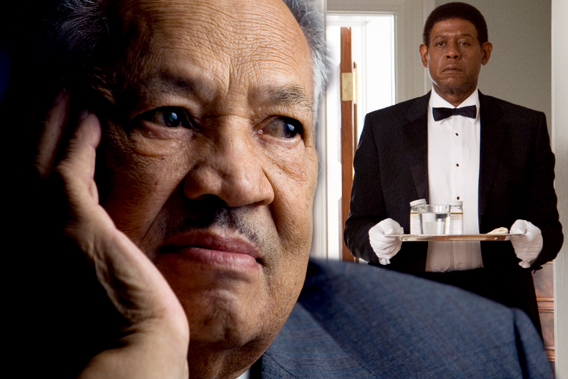
Eugene Allen and Forest Whitaker in The ButlerPhoto illustration by Slate. Photos by Kevin Clark/The Washington Post and courtesy The Weinstein Co.
A few days after Barack Obama was elected president in 2008, the Washington Post published an article about a black butler who served in the White House for 34 years, under eight presidents, from Truman to Reagan. Eugene Allen represented, as journalist Wil Haygood wrote, “a story from the back pages of history. A figure in the tiniest of print. The man in the kitchen.”
“He was there,” Haygood continued, “while America’s racial history was being remade: Brown v. Board of Education, the Little Rock school crisis, the 1963 March on Washington, the cities burning, the civil rights bills, the assassinations.” Allen undoubtedly lived a fascinating life, meeting countless historical figures during especially polarizing times, and it’s unsurprising that Haygood’s profile caught the eye of Hollywood. It is now the basis for Lee Daniels’ The Butler (the director’s name is included thanks to silly copyright claims made by Warner Bros).
But as interesting as Haygood’s profile is, “A Butler Well Served by This Election” doesn’t provide that many details about Allen’s time in the White House outside a handful of facts and humorous anecdotes. (Allen’s wife Helene referred affectionately to former First Lady Rosalynn Carter as “country,” for instance.) The Butler is a bit more than 2 hours long, spans several decades, and includes multiple storylines. It’s fair to say it has epic ambitions.
So how much of Allen’s real-life experience actually made it into the film?
Not much. According to Daniels’ foreword in The Butler: A Witness to History, a book by Haygood published to accompany the film, the movie “is set against historical events,” but “the title character and his family are fictionalized.” The skeleton of Allen’s story is there: the childhood on a plantation in the early 1920s, the interactions with several presidents. But the names have been changed: Allen and his wife, Helene, are called Cecil and Gloria Gaines. (They’re played by Forest Whitaker and Oprah Winfrey.) At least one key character, Cecil’s son Louis (David Oyelowo), is entirely made up.
The following breakdown is based on Haygood’s profile and the accompanying book. (I have emailed Haygood and will update the post if he provides additional information.) Spoilers follow.
The butler’s backstory The film opens with young Cecil in Macon, Georgia, in the 1920s, working in a cotton field alongside his father. His mother (Mariah Carey) is raped by a white plantation overseer, Thomas Westfall (Alex Pettyfer), loud enough for everyone to hear. When Westfall returns, Cecil’s father shows his anger, and Westfall shoots him dead in front of Cecil and the other plantation workers. The plantation matriarch (Vanessa Redgrave) then decides that Cecil should leave the fields to become a “house nigger” and learn to serve her family.
Those appear to be the inventions of screenplay writer Danny Strong; they are never mentioned in Haygood’s piece.* Eugene Allen was born in 1919, and, like Cecil, he grew up on a plantation (in Virginia, not Georgia). He, too, became a “house boy” for a white family. When he spoke to Haygood about his childhood, “There was nary a hint of bitterness in his voice about his upbringing.” Allen left the plantation in hopes of finding better work, as Cecil does—but unlike his fictional counterpart, he never broke into a hotel restaurant to steal food. (He did, however, land a job at a Virginia hotel as a waiter, as Cecil ultimately does in North Carolina.)
How the butler got his job at the White HouseAllen learned of a job at a country club in Washington, D.C., a fact that aligns with Cecil’s move to the nation’s capital. But their entries to the White House differ considerably: Allen learned via word of mouth that Alonzo Fields, a black maître d’ at the White House, was looking for pantry workers, and he went to talk to him. He began working there in 1952, during the Truman administration, but didn’t get promoted to butler until several years later. In the movie, the White House calls Gaines after a white senior staffer witnesses Cecil in action at the D.C. hotel—a point Cecil, in voiceover, emphasizes proudly.
Cecil is hired as butler just as soon as black maître d’ Freddie Fallows (Colman Domingo) confirms that he is not actively political and is experienced in his field. He begins working in the White House under Eisenhower’s administration, in 1957.
Other moments from the film appear to be true: Allen witnessed presidents mulling over important historical decisions, including Eisenhower’s fight with Arkansas governor Orval Faubus regarding the desegregation of Little Rock. And his wife Helene did pass away just prior to Obama’s election (though it was the Sunday night prior, not the morning of, as the film implies).
The butler’s familyAllen had one son, Charles, who served in Vietnam, just as Cecil’s younger son (also named Charles) does. Allen’s son survived the war, while his fictional counterpart does not. The real-life Charles is still alive, and has seen and approved of the new movie, according to Haygood.
The invented older son, Louis, serves as the main source of conflict in the narrative of Cecil’s life, in an attempt to highlight the clash between the older and younger black generation. Louis, who’s ashamed that his father is content with serving white people, is himself present for several important historical moments, including the attack and burning of a Freedom Riders bus in 1961; he’s also imprisoned in the same jail as Martin Luther King, Jr. after a protest.
Gloria Gaines, the butler’swife, has an affair with a neighbor (Terrence Howard) and struggles with alcoholism. These storlines appear to be fictional.
The butler and the Reagans Judging from Haygood’s interview, it seems that Allen, like Cecil, was grateful to have his job at the White House, and wary of involving himself in the politics of the time—even in his old age, he is not quoted saying anything disparaging about the presidents he worked under. In the movie, Cecil asks for equal pay among the black and white service staff, who each perform the same level of duties. His request is denied, and he accepts this. Years later, he again asks for a raise, and when he is turned down a second time, he tells his supervisor that he spoke to President Reagan personally, and that Reagan insists on the raise himself. Allen did receive a promotion to maître d’ in 1980, but there’s no indication that he ever asked for a raise.*
Cecil’s character arc is complete when Nancy Reagan invites him to the state dinner as a guest—the first black butler to receive such an invitation in the history of the White House. This did, in fact, happen to Allen, but the cinematic version unfolds quite differently. Here’s how it’s described in Haygood’s profile:
“Had champagne that night,” the butler’s wife would remember all these years later. As she said it, Eugene, rocking in his chair, just grinned: for so many years he had stocked champagne in the White House.
In the film, on the other hand, Cecil’s discomfort at sitting among the white elite is made clear through voiceover, as he describes feeling like an outsider and a traitor to his black colleagues who are now serving him. He can now see first-hand how each server “performs” for guests, and recognizes that he’s been unknowingly wearing the same mask for years. This moment, along with Cecil overhearing Reagan’s promise to veto the sanctions against apartheid-ridden South Africa, prompts the butler to hand in his resignation. Haygood’s article only mentions that Eugene “left the White House in 1986” and received a “sweet note” from the president and a “tight” hug from First Lady Nancy.
The butler and Obama The film ends with Cecil returning to the White House to meet President Obama. I can't tell if Allen ever actually met the president, but he did get a VIP invitation to the inauguration in 2009, and was in attendance on that historical day. When he passed away in 2010, the president sent a letter to his family acknowledging his years in service and “abiding patriotism.”
Correction, Aug. 15, 2013:This post originally misstated that Lee Daniels co-wrote the script with Danny Strong. While Daniels had some input as to the script, Strong is credited as the sole writer. Due to a publication error inThe Butler: A Witness to History, this post also originally misstated that Allen received a promotion under the Reagan administration.
The truth
is, rap music has its good, bad and ugly. Good being those feel great
tunes with a positive message and substance. Bad being music that may
not appeal to the masses but is entertaining in its own right. And ugly
being that ish that you wish never made it outside of the delusional
rapper who made its thought process. Especially if you are a self
respecting African-American. We are not talking about the run of the mill Southern dance track or
exorbitant East Coast party record. We are talking about the music that
is so coonish that it leaves people wondering if the rapper who made it
has ever heard of the Civil Rights movement, Martin Luther King Jr.,
Malcolm X, minstrel shows, slavery or at least seen 30 minutes of Roots. [Editor's Note: Bamboozled, too.] Hide your kids, hide your white boss/co-workers. Here are 10 songs
- that made it to the mainstream - that most black folks wish other
condescending races never knew existed…
10) “MyBabyDaddy” – B-Rock and The Biz
This song probably has the sad significance of cementing the phrase
“baby daddy” into the mainstream vernacular. Besides letting the world
know that black people can't formulate a proper sentence, the video also
showed that we like to deny fathering kids and dance around doing jigs
while doing it.
09) “Your Momma's On Crack Rock” – The Dogs
Okay, okay, we know we added this song into our list of Anti Drug PSAs,
but that was on some glass half full ish. On some glass half empty ish,
this is some of the saddest ish in Hip-Hop history. Just a little
reminder to let the world know that all Black women are zombied out on
that glass Richard, and that their crack baby children know about it.
08) “Chickenhead” – Project Pat ft. Three 6 Mafia & La Chat
The song's title has the word “chicken” in it, so yeah, it's already
starting off on a bad note. Then raunchy the lyrics and even raunchier
video go hard to keep up the stereotype that black women are money
hungry unfit mothers and young black males are self absorbed misfits.
07) “Baby Mama” – Three 6 Mafia ft. La Chat
Continuing in the “I fathered children and now don't want to take
care of them,” theme, Three 6 helps perpetuate the stereotype that for
Blacks having children is nothing more than a ritual in busting a nut
and collecting a check.
06) "First Of the Month” - Bone Thugz N Harmony
We can't front. This song is a classic. One might even let
his or her white co-worker listen to it telling them how it was their
jam coming up. That is, if you want said co-worker to think all Black
people sit around doing nothing all month and collect a welfare check on
the 1st (provided by their tax dollars) and use it to go buy crack,
kush and beer.
05) "Because I Got High” – Afroman
Surely, this song had a lot of brothers with brown lips getting
turned down for employment in the early 2000's. A nicca wit a Dr J afro
named Afroman talking about nothing but getting high, with chickens, 40
ounces and scantily dressed women dancing around in the video. Who hired
this nicca to make this song, the K-lan ?
04) "Chicken Noodle Soup” – DJ Webstar and Young B Again,
having the word chicken in your title is never a good look. But when you
add a dance that looks eerily similar to the jigs performed at minstrel
shows, you have a recipe for complete coonery
03) "Pants Hang Low” – Plies
We get it. This was supposed to be the rally cry against the proposed
“No Sagging” law that would probably cause racial profiling in the
Black community. But, bruh bruh, no. You and all the rest of these young
punks, pull your fuxing pants up. Stop making Black folks look like got
damb fools.
02) "That Baby Don't Look Like Me” – Shawty Put ft. Lil Jon & Too Short
If you haven't already gotten it yet, the themes here too often are
Black men give no f-cks about their kids. And neither do Black women,
all they want is a check. Thanks, Shawty Put for reinforcing this false
mind set.
01) "Get Smoked” – Lil Mouse
What kind of third world azz ish is this?!? We elected a Black President
four years ago, and a kid who just grew his first pubic hair is rapping
about getting head and killing people. And some adult actually
sponsored this. We got a long way to go, people."
00) "Chain Hang Low” – Jibbs (BONUS MENTION)
This is what happens when you don't have any elders in your circle.
The song that the St. Louis rapper swiped the “CHL” melody from is
actually a minstrel show mainstay entitled “Zip Coon” or “Turkey In The
Straw,” depending on the lyrics. It was only later changed to the
children's song “Ears Hang Low.
Visit the original article to watch the videos of these songs......
~~~~~~~~~~~~~~~~~~~~~~~~~~~~~~~~~~~~~~~~~~~~~~~~~~~~~~~~~~~~
Subscribe! imanifoundation-subscribe@yahoogroups.com .
Visit our Black History Online Class
http://www.blackhistoryclass.blogspot.com
Getting married ? Visit www.happilyeverafter.be
We got Books ! Positive Vibes Litterature 757-523-1399
Viola Davis stepped on to the Oscar's red carpet in a beautiful, strapless emerald green Vera Wang gown and said she purposefully skipped the wig she wears on red carpets and for film roles. It is the first time the actress has rocked her natural short locks on a worldwide stage, and she says her husband, Julius Tennon, saw it as a potential opportunity for empowerment. "My husband wanted me to take the wig off," she told InStyle at a pre-Oscar dinner in Los Angeles. "He said, 'If you want to wear it for your career, that's fine, but in your life wear your hair. Step into who you are!'"
And while Viola has said she's not giving up the wigs for good, wearing her own hair was an excellent choice for a big event like the Oscars. Perhaps she is preparing for a win and a chance to make a statement about her au naturel appearance? Win or lose, the natural look ended up being an excellent choice, proving her family knew best.
Carter G. Woodson (born 1875). Convinced that the history of African-Americans was being ignored and misrepresented, took steps to put things right. In 1915 Woodson founded the Association for the Study of Negro Life and History, now the Association for the Study of African American Life and History (ASALH). The association was created to promote and preserve African-American history and culture. He founded the Journal of Negro History in 1916. Here is the letter than began Negro History Week which became Black History Month.
Launched Negro History Week in 1926, chosen in the second week of February between the birthdays of Frederick Douglass and Abraham Lincoln, which evolved into Black History Month in 1976
Is a member of Omega Psi Phi Fraternity, Inc.
Known for writing the contributions of black Americans into the national spotlight, received a Ph.D at Harvard University
Founded the Association for the Study of Afro-American Life and History in 1915, founded the Journal of Negro History in 1916
Author of the book, "The Miseducation of the Negro", published in 1933
Over the past few days the net has been flooded with the rediscovery of a letter written by a former slave, Jourdan Anderson, to his former master. It seems that the now emancipated Anderson was being asked to return to work as a slave. Jourdan’s response, filled with both angst and frustrations, was nevertheless filled with grace and power. As I read that letter, I was both humbled and empowered. Here was a man who had not only endured but survived and overcame one of the most brutal of American institutions –slavery. But, rather than being broken Mr. Anderson was emboldened, rather than being scared he was strategic, and rather than becoming bitter he became better. Jourdan Anderson was a man who deeply reflected upon the pain of slavery, but did not become consumed with it. He did not spend his time either worrying about his former master or it seems with revenge. As a consequence, while Jordan might have been victimized by slavery, he was not a victim of it. No, he adapted, grew, and finally escaped the cruelest of human situations and he did it and remained sane, whole, and determined. As I think of Black History Month, it is the Jourdan Anderson’s that bring me both joy but also inspiration. And it is this type of celebration that allows us to turn Black History into Black Reality. http://blackimprovement.blogspot.com/2012/01/letter-to-my-old-master-jourdan.html
For all too long, many have taken this celebration as a static, almost dismal period where the staid past is regurgitated, remonstrated, and remembered. But such celebrations rarely lead to any progressive challenges, positive affirmations, or potent rediscoveries. The problem is not the celebration, but the substance of our attention. History, if it is to be of any use, must be more than informative but transformative. It must be more then reflexive but critically reflective. For it is only through a critically reflective dialogue with the past, can we design effective solutions for the present. The past, offering a blueprint of survival and achievement, provides pathways for success and excellence in the world we now live in today. Therefore, it is with joy and anticipation that I read the letter of Jourdan Anderson, as well as Harriet Jacobs “Incidents in the life of an Slave Girl”. Again Jacobs, as was the case with Anderson, does not spend time bemoaning her plight as a slave but articulating her struggle to free her daughters yet enslaved. Harriet Jacobs life was spent preaching the gospel of freedom, love of family and success. In later life, she became one of America’s first champions for a livable wage but unfortunately the value of black labor then, was undervalued, and underappreciated. Her response was not, however to accept this situation but to decry it by declaring ““Don’t believe the stories so often repeated that the negroes are not willing to work. They are generally more than willing to work, if they can get anything for it,”
From entrepreneurs –such as Madame C.J. Walker – to inventors –such as Benjamin Banneker, from actors to activist, from rock stars to astronauts –black genius, ingenuity, and determination has forged a path that has not only made history but has made America what it is today. So rather than dwell on these accomplishments as static, historical oddities –I shall explore them as clues into the mystery of life, as answers to unanswered questions, and as indicators of the possibilities of a new black reality.
*Note: Rodney D. Coates is professor of sociology and gerontology at Miami Unviersity. He can be reached at coatesrd@muohio.edu
Rodney D. Coates* born in East St. Louis, Ill., received his B.A. from Southern Illinois University, a M.A. in sociology and anthropology from the University of Illinois, a second M.A. and Ph.D. in sociology from the University of Chicago. He holds the rank of professor in the Department of Sociology and Gerontology, for 15 years Directed the Black World Studies Program at Miami University. Dr. Coates specializes in the study of race and ethnic relations, inequality, critical race theory, and social justice. Coates serves on the editorial boards of the American Sociological Review; Social Forces; and Race, Class and Gender. He is also on the executive boards of the Southern Sociological Society and Sociologists without Borders. Dr. Coates is the immediate past chair of the Section of Race and Ethnic Minorities of the American Sociological Association, and has served in similar capacities for the Southern Sociological Society. He has published dozens of articles; several edited books, and frequently writes on issues of race and ethnicity, education and public policy, civil rights and social justice. His 2004 edited book Race and Ethnicity: Across time, space and discipline won the Choice award from the American Library Association. This past summer Coates received the Joseph Himes Career Award in Scholarship and Activism from the Association of Black Sociologists. He is currently finalizing an edited volume on /Covert Racism/ for Oxford University Press.
In the folklore and legends of the Netherlands and Belgium, Zwarte Piet (meaning Black Pete) is a companion of Saint Nicholas (Dutch: Sinterklaas) whose yearly feast in the Netherlands is usually celebrated on the evening of the 5th of December (Sinterklaas-avond, that is St. Nicolas Eve) and the 6th of December in Belgium, when they distribute sweets and presents to all good children.
The characters of Zwarte Pieten appear only in the weeks before Saint Nicholas's feast, first when the saint is welcomed with a parade as he arrives in the country (generally by boat, having traveled from Spain). The tasks of the Zwarte Pieten are mostly to amuse children, and to scatter pepernoten and candies for those who come to meet the saint as he visits stores, schools, and other places.
1845: Jan Schenkman writes Saint Nicholas and his Servant; Piet is described in this book as a servant and as black, and is depicted as a dark man wearing Asian-style clothes. Steamboat travel becomes part of the mythos from this point. In the 1850 version of Schenkman's book, they are depicted looking much as they do today. The servant gets his African origin but still has no standard name. In later editions Piet was shown in the page costume, the book stayed (with some changes) in print until 1950 and can be seen as the foundation of the current celebration, even though it did use a lot of older ideas and customs.
1891: in the book Het Feest van Sinterklaas the servant is named Pieter, until 1920 there were several books giving him other names, and in live appearances the name and looks still varied considerably.
In the early 20th century the Civilized Standard Celebration for children, with Zwarte Piet as the standard personal servant of the saint, spread throughout the country. In the 1930s urban adults become more involved too and the arrival of Saint Nicholas and his Zwarte Pieten are staged, which more or less explains the shift from the 6th to the 5th of December, as the adults would celebrate on the eve of the saint's day.
During the 20th century, the number of Sinterklaas' servants multiplied. This paradigm shift opened possibilities to create (for TV and such) lots of different characters being a "Zwarte Piet" at the same time. For example, there's a "Hoofd Piet" (Head Piet) who carries the book of Sinterklaas, "Rijm Piet" (Rhyme Piet), et cetera. Especially during the televised yearly event, when Sinterklaas arrives by boat he is often assisted by dozens of Piets. In america he is called Black Peter. The Dutch now celebrate Sinterklaas (5 December) with an exchange of gifts. These presents are given anonymously, but are often accompanied by poems (Sinterklaasgedicht), signed by "Zwarte Piet" or "Sint", which are read aloud during Sinterklaas evening for the enjoyment of the ones assembled. The poems often are teasing in nature.
Origin and evolution According to myths dating to the beginning of the 19th century, Saint Nicholas (Sinterklaas) operated by himself or in the companionship of a devil. Having triumphed over evil, it was said that on Saint Nicholas Eve, the devil was shackled and made his slave. A devil as a helper of the Saint can also still be found in Austrian Saint Nicholas tradition in the character of Krampus.
Some sources indicate that in Germanic Europe, Zwarte Piet originally was such an enslaved devil forced to assist his captor, but the character emerged in the 19th century within the Netherlands as a companion of Saint Nicholas resembling a Moor.[1] Saint Nicholas is said to come from Turkey. The relation of Zwarte Piet with Haji Firuz is incredibly close, Haji Firuz is a traditional herald of Nowruz, the Persian New Year celebration, exactly black in the face and comes with Amoo Nowruz a white beared old man who brings gifts for the children counter part of Western Santa.
The introduction of this new Zwarte Piet was paired with a change in the attitude of the Sinterklaas character that was often shown as being quite rough against bad children himself and thought unbefitting of a Bishop by teachers and priests. Soon after the introduction of Zwarte Piet as Sinterklaas' helper, both characters adapted to a softer character.[2]
Until the second half of the 20th century, Saint Nicholas' helper was not too bright, in line with the old colonial traditions. Once immigration started from the former colonised countries Zwarte Piet became a much more respected assistant of Saint Nicholas, who is often a bit inattentive.[3]
According to the more modern Saint Nicholas legend, a Zwarte Piet is a servant who accompanies Saint Nicholas on his holiday travels. In some versions, it is alleged that Saint Nicholas once liberated a young slave named Peter, who decided to serve Nicholas (as a free servant) rather than enjoy liberty alone. Zwarte Piet is today commonly depicted as a black person in the colorful pantaloons, feathered cap and ruffles of a Renaissance European page, a tradition based on a single illustration in a book published in 1850.
Zwarte Pieten are often portrayed as mischievous but rarely a mean-spirited characters. Parents used to tell their children that if they have been good, a Zwarte Piet will bring them gifts and sweets, but if they have been bad, a Piet will scoop them up, stuff them in his huge dufflebag and spirit them away to Spain as punishment. Though this is increasingly uncommon nowadays, he can still carry some type or scourge (called a "roe"), especially a a bundle of birch branches, which could be used for birching or in modern words, to chastise children who have been too naughty to deserve presents. The character is believed to have been derived from pagan traditions of evil spirits. Also told for decades is a story that the Zwarte Pieten are black because of chimney soot and/or in mockery of the darker Spanish occupiers of the Low Countries in centuries past.
The traditions of the Saint Nicholas feast are in part at least of medieval origin, if not much older. St. Nicholas himself, as described in the Dutch tradition shows some similarities to Wuotan/Odin, which suggests that the duo have a pre-Christian origin. Possible precursors to Zwarte Piet can be found in Odin's ravens Hugin and Munin.
Zwarte Piet During recent years the role of Zwarte Pieten has become part of a recurring debate in the Netherlands. Present-day observations in the Netherlands under controversy include holiday revellers blackening their faces, wearing afro wigs, gold jewellery and bright red lipstick, speaking in a Surinamese accent,[4] and walking the streets throwing candy to passers-by.
The lyrics of traditional Sinterklaas songs and some parents warn that while Sinterklaas and his Zwarte Pieten will leave well-behaved children presents, they will punish those who have been naughty. For example they will take bad children and carry these children off in a burlap sack to their homeland of Spain, where, according to legend, Sinterklaas and his Zwarte Pieten dwell out of season. A child who has been only slightly naughty will not get a present, but a birching with a "roe", which is a bundle of birch twigs. However, due to the long ago banishment of physical punishments like birching, the legend of birching has been replaced with simply receiving a lump of coal instead of gift. Foreign tourists, particularly Americans, often experience culture shock upon encountering the character (to dress in blackface is a gross taboo in America). Since the last decade of the 20th century there have been several attempts to introduce a new kind of Zwarte Piet to the Dutch population, where the Zwarte Pieten replaced their traditional black make-up with all sorts of colours.[5] In 2006 the NPS (en: Dutch Programme Foundation) as an experiment replaced the black Pieten by rainbow-coloured Pieten, but in 2007 reverted to the traditional all-black Pieten.[6]
For black men who have considered homicide after watching another Tyler Perry movie... By Courtland Milloy milloyc@washpost.com Washington Post Staff Writer Monday, November 8, 2010; 5:30 PM
Can anyone name a movie that came out recently starring a black man who wasn't a sociopath? Someone who had a terrific screen presence, like a young Paul Robeson? And he portrayed a character who was complex and fully drawn? Did he respect black women, too?
Anybody see that movie? I didn't. But surely it's out there somewhere, right? An alternative to those Tyler Perry films portraying black men as Satan's gift to black women? But where is it?
Maybe I didn't hear about it because of all the buzz over Perry's "For Colored Girls," which opened Friday and is based on Ntozake Shange's 1975 stage play, "For Colored Girls Who Have Considered Suicide When the Rainbow is Enuf."
Or maybe I didn't hear about it because I was retching too loudly after seeing "For Colored Girls" - and reading so many inexplicably glowing reviews.
"This movie is powerful," Demetria L. Lucas wrote recently in Essence, the nation's premier magazine for black women. "It is incredible. The performances in it are astonishing, but most of all, this film will leave you lifted."
Me, I thought the movie should have been renamed: "For Black Men Who Have Considered Homicide After Watching Another Perry Movie."
"Oscar buzz, breaking news," read the Hollywood Reporter on Friday. "Will 'For Colored Girls' blindside Tyler Perry's critics?"
Too late. I was blindsided while watching the movie, especially when superstar Janet Jackson appeared onscreen looking like Michael Jackson with breast implants.
"Don't laugh," says Shadow and Act, an online publication about black films and filmmakers. " 'For Colored Girls,' an Oscar contender?"
Oscar for what?
In the category for best infection of a black woman with a sexually transmitted disease that renders her infertile. . . . And the winner is: black man.
For best down-low, double-dealing husband who has sex with wife while sneaking around having sex with men on the streets. . . . And the winner is: black man.
For best portrayal of a guy who at first seems nice but turns out to be a rapist. . . . And the winner is - OMG, his third of the night - black man!
"You may need some time alone after viewing 'For Colored Girls,' " wrote Tonya Pendleton for BlackAmericaWeb.com. "Whatever you may think of the fact that it was Tyler Perry who finally brought the award-winning 1974 Ntozake Shange stage production to the big screen, it will move you."
So will ex-lax.
"You will want to know that two kids get thrown out the window by their father," wrote Jane Nosonchuk for Hamptonroads.com. "The scene is well done."
Do I hear another Oscar nomination?
"The men in the movie are all bad guys except for the cop," Nosonchuk wrote. "They are a means to an end rather than any lead characters. Also, a back-room abortion may disturb some."
You think?
What an awful year for movies featuring black actors. Samuel L. Jackson in "Unthinkable." Thoughtless would be more like it. "Brooklyn's Finest" had a nice cast, with Don Cheadle and Wesley Snipes. But Richard Gere and Ethan Hawke got top billing. "Our Family Wedding" with Forrest Whitaker was okay. But how many black wedding comedies can you watch? Even preacher T.D. Jakes is coming out with his own copycat wedding movie next year.
Surely Spike Lee and Denzel Washington could team up for a sweeping historical drama - say, a black sharecropper's son, educated in a one-room schoolhouse built by slaves in Alabama, who grows up to become one of Wall Street's most powerful CEOs.
Smarter than Gordon Gekko and more complex. With a cameo appearance by former Merrill Lynch chief executive Stanley O'Neal.
Maybe you saw the kind of movie I'm talking about. If not, maybe it's time to make one. milloyc@washpost.com
Historical Information:
The movie "For Colored Girls" weaves together the stories of nine different women - Jo, Tangie, Crystal, Gilda, Kelly, Juanita, Yasmine, Nyla and Alice - as they move into and out of one another's existences; some are well known to one another, others are as yet strangers. Crises, heartbreaks and crimes will ultimately bring these nine women fully into the same orbit where they will find commonality and understanding. Each will speak her truth as never before. And each will know that she is complete as a human being, glorious and divine in all her colors. Starring:Janet Jackson, Loretta Devine, Michael Ealy, Kimberly Elise, Omari Hardwick, Hill Harper, Thandie Newton, Phylicia Rashad, Anika Noni Rose, Tessa Thompson - Director:Tyler Perry - Release Date:Opened Nov 5, 2010
The play "For Colored Girls Who Have Considered Suicide When the Rainbow Is Enuf" is a 1975 play by Ntozake Shange. Initially staged in California, it has been performed Off-Broadway and on Broadway, and adapted as a book, a television film, and a theatrical film. The 1977 Broadway production was nominated for a Tony Award for best play.